
Lower School
Tactile Imaginative Experiences: Grades 1-5
As children begin their Waldorf journey, they explore basic academic concepts like addition and reading through storytelling, painting and music. Their days are filled with reenactments of history, creation of music and other hands-on activities that help them understand each concept – not memorize it.
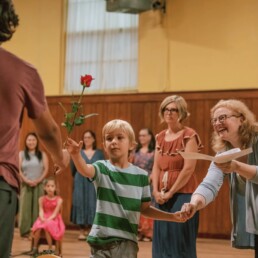
Grade 1
These children enter the grades surrounded by beauty and immersed in wonder, music and movement. Writing evolves from painting, drawing and story; reading evolves from writing. Through imaginative and tactile means, students are introduced to the four processes of math. Fairy tales and nature stories awaken the child’s interest in the world. Song and dance, playing various instruments, handwork, and world language weave meaningfully into the first grade experience.
Grade 2
The Waldorf teacher stays with the class from first to second grade, and continues with them through all eight years whenever possible. This continuity of class and teacher allows for a learning community with a strong foundation. The second grader meets a language arts curriculum rich with the contrasts between the lives of saints and people, and the foibles of the animals in Aesop’s fables. Basic arithmetic operations are expanded and multiplication facts are learned through rhythm and movement. The children’s artistic work includes painting, drawing and modeling. Students learn to play the pentatonic lyre.
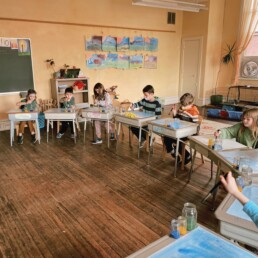
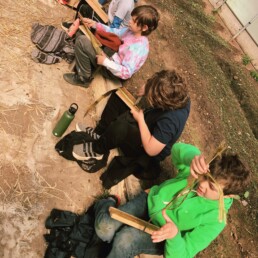
Grade 3
Physical growth accelerates during the transition period of the nine- to ten-year-old child, who is growing into a new awareness of self. The child’s relation to the world changes; study now has a more realistic, practical character. Lessons include learning how different parts of life mutually support one another, as on a farm. Third-graders study shelter and house-building. Math becomes practical: measuring, cooking, telling time and using money. Stories, which may parallel the children’s own inner journeys, are heard, written and illustrated. Students learn to play the diatonic flute or recorder.
Grade 4
Constantly in motion and seeking boundaries, the fourth-grader is met with a rich curriculum including a study of one’s physical place on the earth, through local history and geography; the human relationship to the animal world, through zoology; and the work of good and evil, through Norse mythology. Math’s critical new step—the breaking of the whole, fractions—lays a foundation for higher math and abstract thinking skills. In music, the child’s strengthening individuality allows each to hold his or her own in part-singing and in orchestra where playing string instruments enhances brain hemisphere integration.
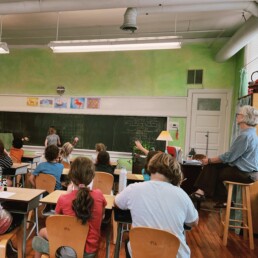
Grade 5
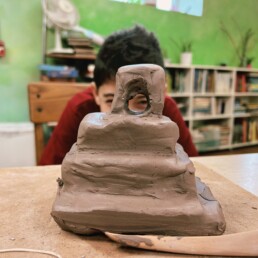
Students continue their rich experience with language and visual arts as they move from myth into history through the study of ancient civilizations, India through Greece. This study, brought through story, poetry and song, stirs the child to a more intense experience of human connections. Inquiry into U.S. geography and botany bring the child into a recognition of chance and metamorphosis. Geometry is explored through free-hand rhythmic drawings. Decimal fractions further their exploration of part and whole, and students begin woodworking, which grows from their study of trees in botany.