
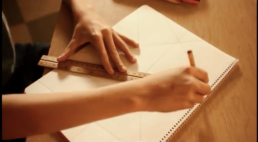
from the early grades and beyond, students give shape to geometry
For students studying geometry at the Susquehanna Waldorf School, precision is compatible with beauty. Each student’s lesson book not only illustrates their knowledge and understanding, but also showcases their individual creativity and personality as they add their own color and shading to their construction. The result is a classroom brimming with richly colored and rigorously made shapes, integrally tied to mathematical understanding.
“We want the students to understand visually how the formulas work, not just memorize the formulas,” explains Leilani Richardson, Grade 6 teacher. As early as Grade 2, students begin laying the groundwork for geometry by creating form drawings and exploring multiplication through a circular times table. This advances to connecting points on a page with a ruler, and goes on to yield an exponentially broader range of form and color as students learn to bisect lines and angles. The technical terminology advances with the drawings, introducing the names of angles, line segments, and concepts. By the time the students reach the higher grades, they are well prepared for the rigor of constructing complex shapes and grasping advanced theories.
Constructing the shapes in the higher classes takes an enormous amount of focus and self-discipline. Pedagogically, this touches on a key aspect of the students’ development. “At this age, their bodies and their inner world are askew. They are growing and changing so rapidly, and the work to create these geometric drawings brings order and focus to their thinking. It is very comforting to them,” says Richardson. Students are also given an opportunity for self-discovery and self-direction. In one exercise, students are asked to determine the area of a triangle with just a square of paper. Not only does this encourage the student to find the connection independently, but it also gives them an opportunity to clearly express their discovery in words and in a mathematical language.
Beginning in the early grades as simple form drawings and progressing into the higher classes as meticulously constructed shapes, geometry in the Waldorf curriculum goes beyond the calculations and formulations to get at the very essence of shapes. It is a development of mathematical thinking that creates an understanding of the whole to the parts, and connects its students to the source.

SWS Students Become Force, Weight and Motion in Middle School Physics
The methodology for science instruction in Waldorf Education is based on observation and Socratic Inquiry. Students of all ages are immersed in observation and manipulatives, experienced during regular nature walks, gardening, cooking, form drawing and experimentation, to name only a few. By the time they enter middle school, Waldorf students begin the study of Physics, Chemistry, Anatomy, Physiology, Geology, Astronomy, Meteorology, and Botany, which is first introduced in fifth grade. At this level, Waldorf teachers begin not by lecturing on rules and formulas, but by showing those rules in action through experiments, the natural world, art and music. These real world examples and applications are used to then guide students to use Socratic inquiry and observation to connect logical parts to the whole, which helps them deeply understand the science within our world.
At Susquehanna Waldorf School, the seventh grade recently reinforced that science can come to life as they demonstrated their Physics and Simple Machine experiments to the student and parent body at a school assembly. Using themselves as weight, force, and motion, they were able to affect balance through a fulcrum, lifting through pulleys, force from a small wedge, and motion with the help of wheels and axles.
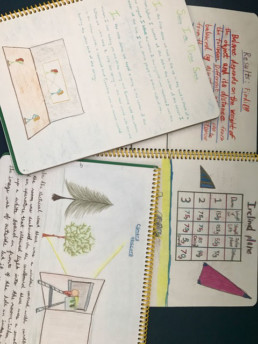
Other experiments and demonstrations the seventh grade participated in during their Physics block were building a simple motor as part of their study of electricity, identifying reflections and images in mirror space observations, and conceptualizing the complex workings of the camera obscura. As a final lesson review, and unique to Waldorf education, students then explained (composed) and illustrated what they learned in their self-made textbooks, also known as main lesson books.
A study of Waldorf alumni, conducted by AWSNA, the Association of Waldorf Schools of North America, found that Waldorf graduates are almost two times more likely than the usual U.S. graduate to declare majors in Math and Science. This may be attributed to the creative and imaginative capacities developed and explored first in the lower grades and then into the middle school Waldorf science classes.
Postcard Exchange Helps Students Broaden Horizons
The Susquehanna Waldorf School (SWS) is participating in a worldwide postcard exchange initiative to both broaden the global perspective of students and kick-off the 100 year celebration of Waldorf® Education planned for 2019.
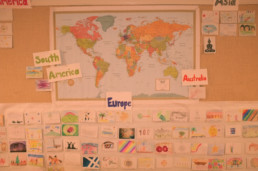
Throughout the current year, students in 1,100 Waldorf schools from greater than 80 countries will send a postcard to every other Waldorf school in the world. Each postcard is being individually designed by a young person, telling or showing something of his or her country, school, or self.
This innovative global project will connect hundreds of thousands of students to one another through individualized and artistically designed postcards, which will then be arranged, by each school, into a Global Map for public display.
SWS is proud to be a part of this million-fold Waldorf greeting from around the globe! Class Five teacher, Elizabeth Curtis, shares that her students “eagerly anticipate arrivals of cards from far-away lands” and are finding connection with other Waldorf students through the process.
See how students are broadening their horizons!