
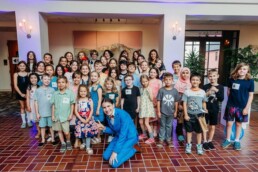
Student Spotlight: Lucas and Peace Kids Art to the Rescue
At the Susquehanna Waldorf School, we take pride in nurturing not only the intellectual and creative capacities of our students, but also their sense of purpose and compassion for the world. One shining example of this is Lucas Kreider, a remarkable middle school student whose vision and heart have brought a growing community project to life: Peace Kids Art to the Rescue, a unique annual art auction with a mission.
Peace Kids Art to the Rescue is more than an art show, it’s a movement of young artists using creativity as a catalyst for kindness. Each year, the event brings together students to share their artwork and raise funds to support those in need. What began as one child’s wish to help others has blossomed into a tradition that unites community, compassion, and creativity.
When asked what first inspired him, Lucas reflected, “When I was five years old, my mom and I used to drive around and give out kindness bags to people experiencing homelessness. This exposure led me to want to do more for people who had less than I did. At that time I was really into art, so over breakfast one morning, I asked my mom whether we could have a children’s art show so we could raise money for those in need.”
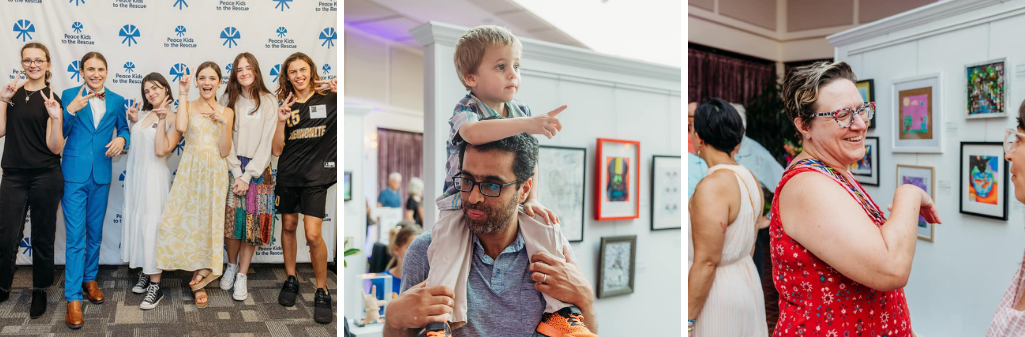
From that simple idea came an initiative that has grown every year—powered by dedication, collaboration, and heart. Over time, Lucas has seen how the event has become a reflection of the generosity within his community. “I am inspired that the community has taken so well to this event and that they can unite for a good cause,” he shared. “As for myself, I have learned that how I treat someone has a ripple effect on how they treat others. Kindness grows!”
Lucas credits his Waldorf education as a key influence in both his artistic expression and his confidence to bring his ideas to life. “Waldorf education is very art driven, so that is likely where my interest in art came from. Also, going to a Waldorf school has helped me feel safe to be myself and given me confidence to pursue my dreams.”
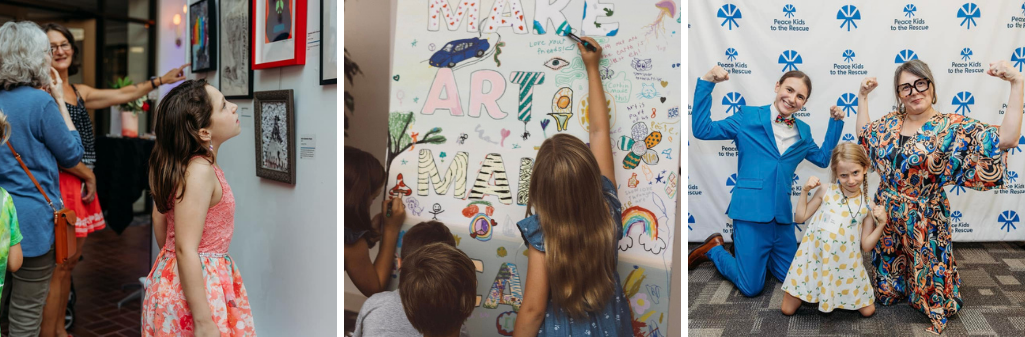
Of course, growing a community initiative hasn’t been without its challenges. Lucas spoke candidly about some of the obstacles he and his family have faced: “Finding money and donations to put on the show and grow it has been an ongoing challenge. Another problem we have encountered is attempting to have children of different backgrounds—sexual orientation, ethnicities, gender identification, religion, socioeconomic status—participate in the show.”
In true Waldorf spirit, Lucas and his team have met these challenges with creativity and perseverance. “To raise money, we’ve expanded what we offer by adding periodic Peace Art Workshops, with the revenue going toward growing the show. We’ve also begun to apply for grants. Increasing diversity among young artists continues to be a challenge, which we’re addressing by meeting with nonprofits who support children in some capacity.”
Through every phase of the project, Lucas’s motivation remains rooted in service and inspiration. “I hope that children and young adults will be inspired by Peace Kids to start their own projects—car washes, lemonade stands—to support those marginalized in their communities. I also hope that kids feel a sense of pride and confidence in themselves through being in the art show.”
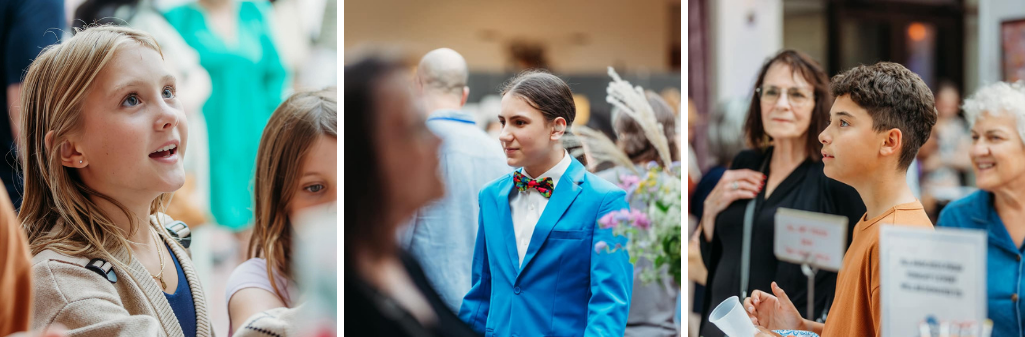
Lucas and Peace Kids Art to the Rescue exemplify Susquehanna Waldorf School’s mission to cultivate compassionate, creative, and confident individuals who bring light and purpose to the world. Lucas’s story demonstrates that when education nourishes both the heart and the imagination, extraordinary things can grow.
To learn more about Peace Kids Art to the Rescue or to make a donation, visit peacekidsart.com.
Special thanks to the many SWS students and alumni who have contributed their talents and spirit to Peace Kids over the years:
Catherine Myers, Sophia Anderson, Iris Clements, Gus Kramer, Sylvia Kramer, Claire Pargament, Junie Whitaker, Izzy Wilmoth, Evie Wilmoth, Ava Ruggley, Olivia Franklin, Lyla Franklin, Mia Franklin, Will Lutz, Colette Myers, Lucy Fletcher, David Long, Gisela Pecora, Delaney Grimes, Dempsey Grimes, and Mary Wolgamuth.

Why is Waldorf Education the fastest-growing educational movement?
Why is Waldorf Education the fastest-growing educational movement?
A personal perspective.
Waldorf Education is reported to be the fastest-growing non-sectarian, independent educational movement in the world. According to data from 2022, Waldorf World List there are 1,270 Waldorf and Rudolph Steiner Schools in 80 countries and 1,928 Waldorf Kindergartens in more than 70 countries. This global expansion shows that parents all over the world are seeking a holistic education for their children.
Thirteen years ago, as parents of a two-year-old and 11-month-old, we began researching schools for our oldest child. Unfamiliar with Waldorf education, we found Susquehanna Waldorf School’s website and decided to attend an Open House. On the day of the visit, my toddler refused to wear clothes, so we arrived late. I entered the beautifully historic school feeling embarrassed and weary, carrying a reluctant two-year-old. I'd missed the tour, but a kindergarten teacher, Ms. Wendy, warmly welcomed us. My son promptly took off his shoes and began exploring the classroom while I worried about how inappropriate this might be. Ms. Wendy crouched down and spoke to my son in a beautiful way, and he was captivated. She understood him, she welcomed us, and I immediately knew we’d found a rare gem of a school. We never made it past the kindergarten classroom that day, but we had all the information we needed— this was a place of beauty, joy, respect, and acceptance with teachers who truly understood children’s needs.
Now, years later, as SWS’ Admissions Coordinator, I have the privilege of introducing families to SWS and Waldorf Education. Many of these families arrive seeking an alternative to public or other independent school options. They are often captivated by the hallmarks of the school— the joyfully balanced, holistic approach to education, the warmth of the community, and the beauty of the physical space. Our new families are generally seeking three things that Waldorf education uniquely provides: community, connection to nature, and a balanced curriculum rooted in a knowledge of child development.
 1) Community
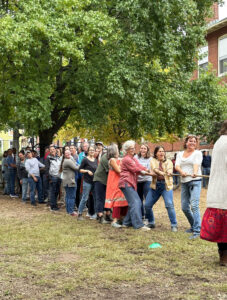
Many prospective families have children born just prior to or during the pandemic. These children have often experienced isolated early years, and parents are eager to support their social-emotional development. Parents are amazed when they witness SWS’s play-based early childhood classrooms, lively with snack preparation, artistic endeavors, and deep imaginative play. Interactions with peers are opportunities to experience cooperation, conflict resolution, empathy, and redemption— keys to healthy social development. Loving teachers and assistants support children as they navigate the sometimes bumpy efforts of working within a community.
Parenting can be isolating and confusing. Many parents seek not only to support their child’s social development but also a desire to find a place where the whole family becomes part of a community. The SWS parent community and parent education offer a warm embrace and connection for families seeking a like-minded approach to parenting. Alum parent and Board President Dave Knapp reflects that through his involvement in the SWS community, “I learned at least as much as my children did, I became a better parent, a better person… know that this school is going to change your life. It’s changed mine.”
 2) Connection to Nature
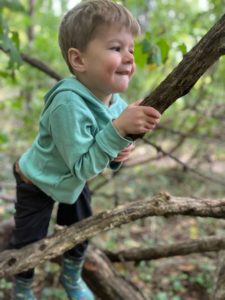
Research emphasizes the importance of getting outdoors, especially for young children. Being in nature supports a child’s social-emotional regulation, mental health, intellectual development, and increases motor skill development. The Child Mind Institute explains why outdoor play is so important for children, “Spending time in nature can build their confidence. There's a lot less structure than most types of indoor play, and they can choose how they interact with the nature around them. This gives them practice managing their own actions and encourages creativity and imagination.”
At SWS, our emphasis on physical movement throughout the day is becoming more and more unique. Our students delight in going outdoors for recess or nature walks twice a day all the way through 8th grade, regardless of the weather. As Waldorf teachers love to share, “There’s no bad weather with the right gear.” Our students experience the joy of the changing seasons through direct observation. As one Kindergarten parent, Laura K. shared, “We know we would’ve wanted it for ourselves, so it’s a gift to our children.”
 3) Curriculum
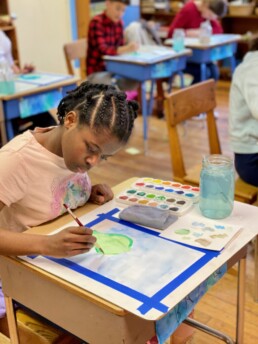
Many families find SWS after recognizing that their local public or independent schools haven’t been a fit for their children. Technology is taking the place of experiential, hands-on learning and parents are noticing the detrimental effect it has on their children. They notice their child is anxious and overwhelmed by large class sizes and no longer enjoys school—many share the “spark” of learning has gone out. The Waldorf curriculum is infused with art, music, and movement and children learn traditional concepts in age-appropriate and imaginative ways, making learning engaging at all levels. The Waldorf curriculum encourages the development of skills and the capacity for learning. The whole child (“head, heart, hands”) is considered in each level of development, providing a balanced foundation for lifelong learning. SWS students graduate not only with the skills needed for high school but also an intrinsic motivation and excitement for learning. New parent, Sherrie M. shares the world of difference since coming to SWS, “Prior to coming our older daughter did not like school and did not enjoy her experience in public school. Coming to this school, now she doesn’t like weekends anymore because she wants to be at school! That’s a complete 180. She loves the community, her teacher, her classmates. We’ve seen such growth in her reading, math has been explosive for her— the uncovering of what’s underneath represents such growth.”
Many years ago, we began our family’s journey at SWS, enrolling in the Parent-Child class. We weren’t sure if this would be a long-term educational fit and had no idea what lay ahead. Through the steadfast support of teachers and fellow parents, we began to learn about the truly unique Waldorf curriculum and have seen our three children thrive—growing and developing into strong artists, musicians, scholars, and athletes. I wanted my children to love learning, to be curious, and to be stretched. Now, with the perspective of 13 years, one graduate and another soon to be, I couldn’t imagine that my children could get as rich an education anywhere else.