
There is a story circulating from a longtime public high school woodshop teacher, thirty years in the classroom, sawdust in his lungs, scars on his hands. In the story, a student stands trembling with anger, holding a mallet, overwhelmed by a world that feels too loud and too divided.
The teacher doesn’t call security. He doesn’t escalate.
He hands the student a block of rough wood and tells him to sand.
What follows is not a lesson in woodworking. It’s a lesson in being human.
The students sand knots and splinters. They feel resistance. Their arms grow tired. The room fills with the smell of wood dust and effort. Slowly, something shifts. When the beeswax is finally rubbed into the grain, beauty emerges, not despite the imperfections, but because of them.
This story resonates because it names something many of us feel, but struggle to articulate: children today are overwhelmed, disembodied, and hungry for experiences that feel real.
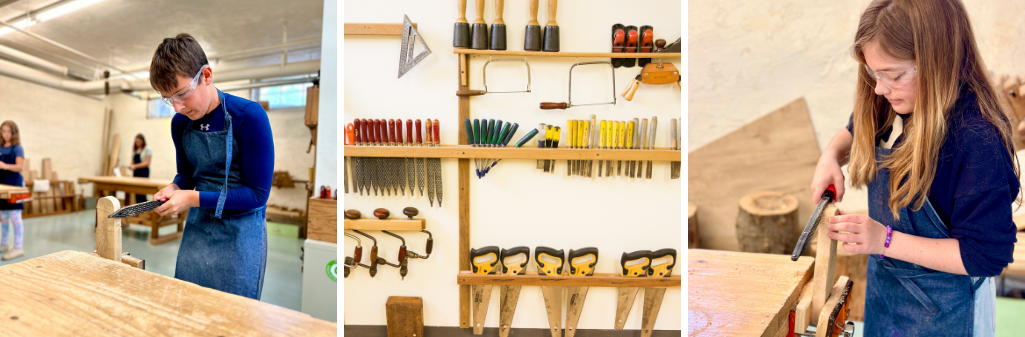
At Susquehanna Waldorf School, this understanding is not new. Long before smartphones and virtual reality, Waldorf education recognized that children develop resilience, confidence, and emotional regulation through meaningful work with their hands.
Handwork, Practical Arts, farming, baking, painting, these are not “extras.” They are essential.
When a child sands a piece of wood, they encounter friction. They learn patience. They discover that transformation takes time and effort. They experience agency: I can change this with my own hands.
In a digital world, discomfort can be avoided with a swipe. Mistakes can be edited quickly. In real life, growth requires staying present. Sanding teaches what scrolling cannot.
This is why technology is introduced intentionally and developmentally at Waldorf schools. Not because we reject the future, but because we understand what children need in order to meet it with strength and discernment.
You cannot download resilience.
You cannot 3D-print character.
But you can cultivate them, slowly, rhythmically, and with care, by giving children work that is real, grounding, and human.
In times of cultural noise and emotional heaviness, embodied work matters more than ever. This is how grit is made.
Original story from Decode Vale.