
You Can’t Download Resilience
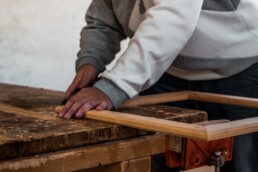
There is a story circulating from a longtime public high school woodshop teacher, thirty years in the classroom, sawdust in his lungs, scars on his hands. In the story, a student stands trembling with anger, holding a mallet, overwhelmed by a world that feels too loud and too divided.
The teacher doesn’t call security. He doesn’t escalate.
He hands the student a block of rough wood and tells him to sand.
What follows is not a lesson in woodworking. It’s a lesson in being human.
The students sand knots and splinters. They feel resistance. Their arms grow tired. The room fills with the smell of wood dust and effort. Slowly, something shifts. When the beeswax is finally rubbed into the grain, beauty emerges, not despite the imperfections, but because of them.
This story resonates because it names something many of us feel, but struggle to articulate: children today are overwhelmed, disembodied, and hungry for experiences that feel real.
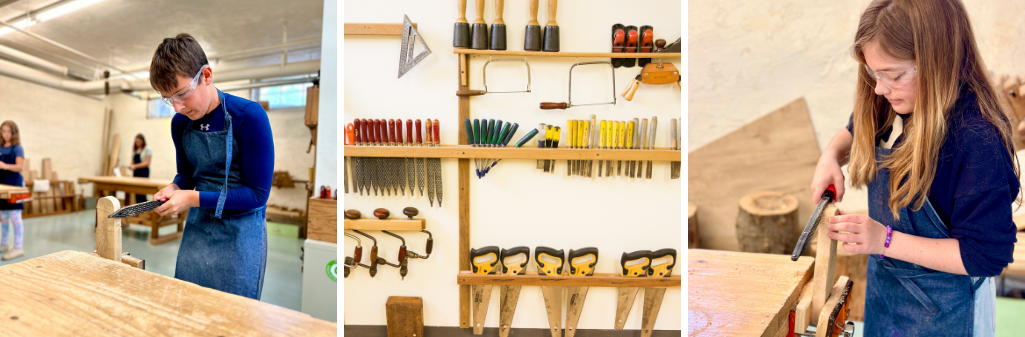
At Susquehanna Waldorf School, this understanding is not new. Long before smartphones and virtual reality, Waldorf education recognized that children develop resilience, confidence, and emotional regulation through meaningful work with their hands.
Handwork, Practical Arts, farming, baking, painting, these are not “extras.” They are essential.
When a child sands a piece of wood, they encounter friction. They learn patience. They discover that transformation takes time and effort. They experience agency: I can change this with my own hands.
In a digital world, discomfort can be avoided with a swipe. Mistakes can be edited quickly. In real life, growth requires staying present. Sanding teaches what scrolling cannot.
This is why technology is introduced intentionally and developmentally at Waldorf schools. Not because we reject the future, but because we understand what children need in order to meet it with strength and discernment.
You cannot download resilience.
You cannot 3D-print character.
But you can cultivate them, slowly, rhythmically, and with care, by giving children work that is real, grounding, and human.
In times of cultural noise and emotional heaviness, embodied work matters more than ever. This is how grit is made.
Original story from Decode Vale.


The Power of Rhythm: How Waldorf Education Builds Resilience
January often arrives quietly. After the brightness and bustle of the holidays, families return to routines, classes settle back into familiar patterns, and the steady work of the school year resumes. In Waldorf education, this return to rhythm is not accidental. It is essential.
Rhythm is one of the most powerful and supportive tools we offer children. It creates a sense of security, builds resilience, and allows learning to unfold with confidence and calm.
Why Rhythm Matters
Children thrive when their days have a predictable flow. Knowing what comes next allows them to relax into the moment at hand, freeing their energy for learning, creativity, and connection. In Waldorf classrooms, rhythm shapes the day, the week, and the year.
Morning circles, focused academic work, artistic practice, outdoor play, and closing activities arrive in a consistent order. This repetition is not rigid. It is reassuring. Over time, it helps children develop inner steadiness and trust in their environment.
Rhythm as a Foundation for Resilience
Resilience is often misunderstood as toughness or independence. For children, true resilience grows from feeling safe, supported, and understood. Rhythm provides that foundation.
When challenges arise, a new academic concept, a social struggle, or a moment of frustration, children are better able to meet them because their world feels reliable. The steady rhythm of the classroom becomes an anchor. From that place of security, children are more willing to try, to persist, and to grow.
Seasonal Rhythm and the Winter Months
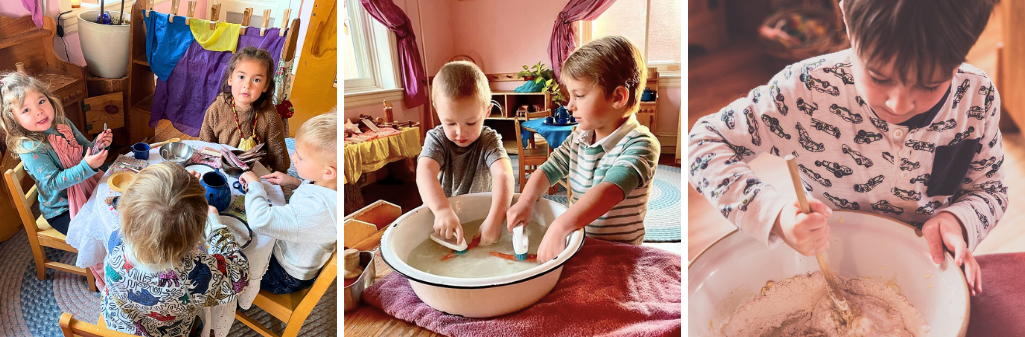
Winter brings a natural turning inward. In Waldorf education, we honor this seasonal shift by slowing down, deepening focus, and nurturing inner life. Storytelling, handwork, music, and thoughtful academic work support children during this quieter time of year.
Outdoor play remains an important part of the day, even in the cold. Time in nature builds physical resilience and reminds children that they are capable and strong in all seasons.
Rhythm Beyond the Classroom
Families often tell us that Waldorf rhythm extends into their home life in meaningful ways. Regular mealtimes, bedtime routines, weekly traditions, and seasonal celebrations all echo the rhythms children experience at school.
These simple patterns help children feel grounded and connected, especially during times of transition. They also offer parents a sense of steadiness in the busy work of family life.
Rhythm Begins with the Grown-Ups
Children learn rhythm not only by living within it, but by watching the adults around them strive toward it. This does not require perfection, nor does it demand a tightly scheduled home. Even the most flexible families can offer rhythm in small, human ways.
When parents choose one or two steady touchstones in their own day, such as morning tea before the house wakes, a walk after dinner, or lighting a candle before bedtime, they model something powerful. They show that life has anchors. These moments become a kind of safe harbor, grounding both parent and child.

A Gift for Life
As we begin the new year together, we are reminded that resilience does not come from rushing ahead. It grows quietly through consistency, connection, and the gentle strength of rhythm. Rhythm offers a sense of arrival. A feeling that no matter how full or scattered the day has been, there is a place where we come back together. Children feel this deeply, and parents often discover that these gentle routines nourish them just as much.
Winter, especially, invites us to slow down. The darker evenings and quieter pace of the season support earlier bedtimes, shared meals, and moments of connection that do not require planning or performance. Reading aloud, cooking together, handwork at the table, or simply sitting close at the end of the day all build warmth and belonging.
Rather than adding more, rhythm often asks us to do less. To repeat what works, to linger a little longer, and to allow creativity and connection to arise naturally. Over time, these small, steady gestures weave themselves into family life, offering reassurance, calm, and a deep sense of security.
In this way, rhythm becomes a shared gift. A grounding presence. A safe landing for everyone.

The Importance of Community for Parents
Parenting young children is both beautiful and demanding. Between drop-offs, lunches, work, and daily life, it’s easy to feel like you’re carrying the load alone. But the truth is, we’re not meant to parent in isolation.
Historically, raising children was shared by extended families, neighbors, and whole villages. Today, schools have become one of the most natural places for parents to find that same connection. The families we meet through our children’s classrooms often become the friends, supporters, and allies who walk this parenting journey alongside us. At Susquehanna Waldorf School, community is not just a bonus - it’s at the heart of everything we do.

Community at the Heart of Waldorf Education
In Waldorf education, community is a foundational principle. The relationships between students, parents, and teachers are strengthened through shared experiences, long-term connections, and active participation in school life. From festivals and Parent Guild meetings to classroom volunteering and assemblies, the rhythm of the year is built around opportunities to gather, celebrate, and support one another.
This sense of belonging not only enriches the life of the school, but it also serves as a model for our children. When they see adults working together with care and dedication, they learn the values of collaboration, compassion, and shared responsibility.
What Community Looks Like at SWS
- Teacher-Family Relationships: Our teachers nurture deep, long-term connections with students and families. While a teacher may not always journey with a class from 1st through 8th grade in the full Waldorf tradition, the focus remains on developing multi-year relationships to their fullest. Even when challenges arise, working through them with openness and respect gives children a living example of healthy, resilient relationships.
- Shared Responsibility: Parents are considered vital partners in the educational process. Their time, energy, and creativity bring life to the school in countless ways. From helping at festivals to lending expertise on committees, parents’ contributions make SWS what it is.
- Parent Guild: Parent Guild serves as the heartbeat of parent involvement, coordinating volunteers, fostering friendships, and providing a network of support. It’s not just about getting things done, it’s about building community while doing it
- Festivals and Celebrations: Seasonal and cultural festivals are a cherished Waldorf tradition, offering meaningful opportunities for families to connect. Watching a new first-grader receive a rose from their eighth-grade buddy at the Rose Ceremony is unforgettable, not only for that moment, but because we know in time, that same child will stand tall as the older student offering a rose to the next little one.

The Benefits of Belonging
- Support for Students: A strong community helps children build motivation, resilience, and social-emotional skills while giving them a true sense of belonging.
- Growth for Parents: Engaging in school life isn’t only about supporting your child; it’s also a path of personal growth. Parents discover new skills, reflect on their own journeys, and form friendships that last well beyond the school years.
- A Living Model: Children learn best by example. Seeing their parents and teachers invested in community teaches them the importance of showing up for something larger than themselves.
- Lasting Relationships: The long-term connections formed here become deep friendships and a sense of stability that often carry forward into adulthood.
We’re In This Together
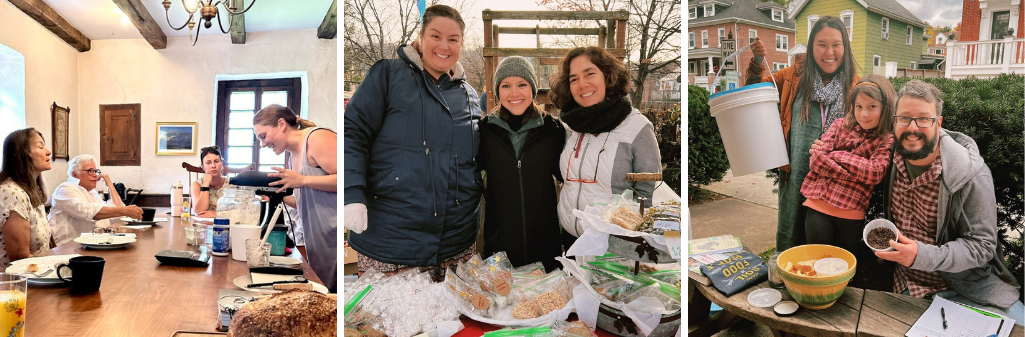
The years of raising young children are full and demanding, but they are also rich with opportunities to create bonds and shared purpose. At Susquehanna Waldorf School, parents quickly discover they’re not just dropping children off each day; they’re stepping into a living, breathing community of families, teachers, and staff, all working together for the children’s well-being.
Because at SWS, school is not only where children learn. It’s where families grow, too.

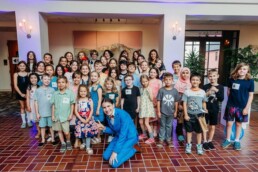
Student Spotlight: Lucas and Peace Kids Art to the Rescue
At the Susquehanna Waldorf School, we take pride in nurturing not only the intellectual and creative capacities of our students, but also their sense of purpose and compassion for the world. One shining example of this is Lucas Kreider, a remarkable middle school student whose vision and heart have brought a growing community project to life: Peace Kids Art to the Rescue, a unique annual art auction with a mission.
Peace Kids Art to the Rescue is more than an art show, it’s a movement of young artists using creativity as a catalyst for kindness. Each year, the event brings together students to share their artwork and raise funds to support those in need. What began as one child’s wish to help others has blossomed into a tradition that unites community, compassion, and creativity.
When asked what first inspired him, Lucas reflected, “When I was five years old, my mom and I used to drive around and give out kindness bags to people experiencing homelessness. This exposure led me to want to do more for people who had less than I did. At that time I was really into art, so over breakfast one morning, I asked my mom whether we could have a children’s art show so we could raise money for those in need.”
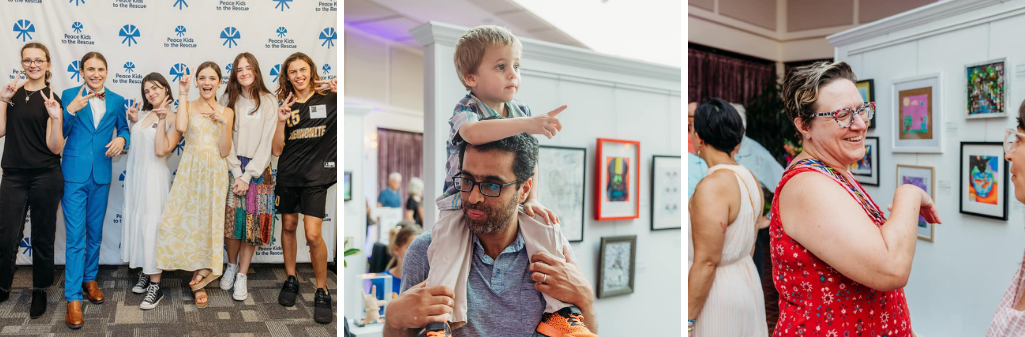
From that simple idea came an initiative that has grown every year—powered by dedication, collaboration, and heart. Over time, Lucas has seen how the event has become a reflection of the generosity within his community. “I am inspired that the community has taken so well to this event and that they can unite for a good cause,” he shared. “As for myself, I have learned that how I treat someone has a ripple effect on how they treat others. Kindness grows!”
Lucas credits his Waldorf education as a key influence in both his artistic expression and his confidence to bring his ideas to life. “Waldorf education is very art driven, so that is likely where my interest in art came from. Also, going to a Waldorf school has helped me feel safe to be myself and given me confidence to pursue my dreams.”
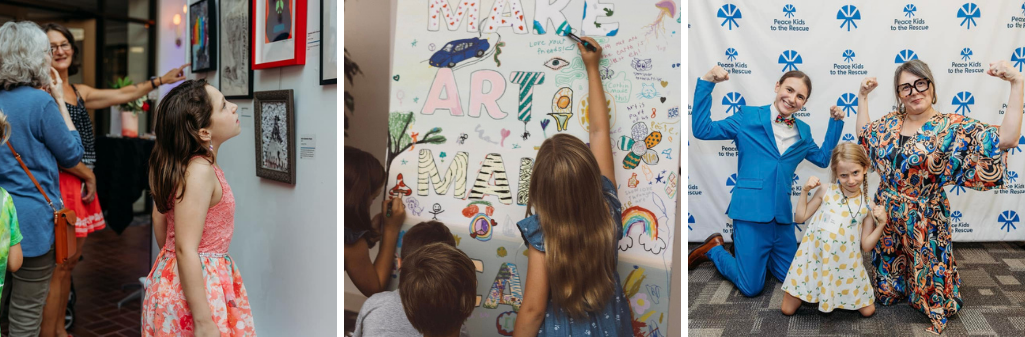
Of course, growing a community initiative hasn’t been without its challenges. Lucas spoke candidly about some of the obstacles he and his family have faced: “Finding money and donations to put on the show and grow it has been an ongoing challenge. Another problem we have encountered is attempting to have children of different backgrounds—sexual orientation, ethnicities, gender identification, religion, socioeconomic status—participate in the show.”
In true Waldorf spirit, Lucas and his team have met these challenges with creativity and perseverance. “To raise money, we’ve expanded what we offer by adding periodic Peace Art Workshops, with the revenue going toward growing the show. We’ve also begun to apply for grants. Increasing diversity among young artists continues to be a challenge, which we’re addressing by meeting with nonprofits who support children in some capacity.”
Through every phase of the project, Lucas’s motivation remains rooted in service and inspiration. “I hope that children and young adults will be inspired by Peace Kids to start their own projects—car washes, lemonade stands—to support those marginalized in their communities. I also hope that kids feel a sense of pride and confidence in themselves through being in the art show.”
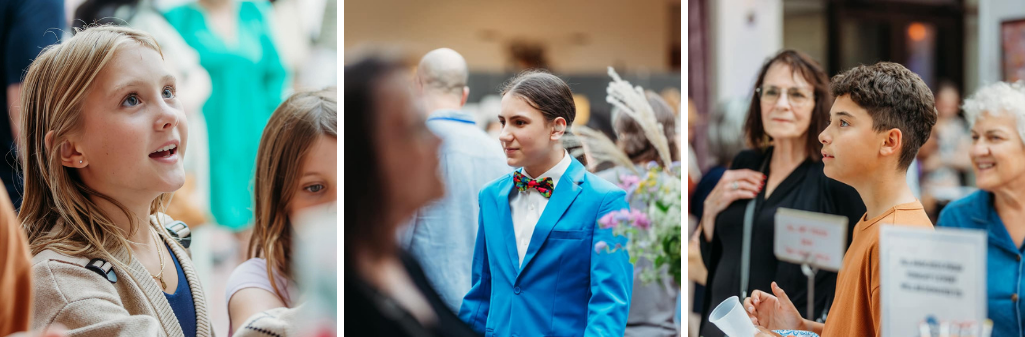
Lucas and Peace Kids Art to the Rescue exemplify Susquehanna Waldorf School’s mission to cultivate compassionate, creative, and confident individuals who bring light and purpose to the world. Lucas’s story demonstrates that when education nourishes both the heart and the imagination, extraordinary things can grow.
To learn more about Peace Kids Art to the Rescue or to make a donation, visit peacekidsart.com.
Special thanks to the many SWS students and alumni who have contributed their talents and spirit to Peace Kids over the years:
Catherine Myers, Sophia Anderson, Iris Clements, Gus Kramer, Sylvia Kramer, Claire Pargament, Junie Whitaker, Izzy Wilmoth, Evie Wilmoth, Ava Ruggley, Olivia Franklin, Lyla Franklin, Mia Franklin, Will Lutz, Colette Myers, Lucy Fletcher, David Long, Gisela Pecora, Delaney Grimes, Dempsey Grimes, and Mary Wolgamuth.

Susquehanna Waldorf School Named Best Private School in Lancaster County
We’re thrilled to share some wonderful news! 🎉
Susquehanna Waldorf School (SWS) has been named “Best Private School” in Lancaster by Lancaster County Magazine’s annual Best of Lancaster awards.
This recognition is a heartfelt reflection of our incredible community - the students, families, teachers, and staff who bring Waldorf education to life every single day.
A Celebration of Our Community
It takes many hands, many voices, many hours, and a great deal of love to make Susquehanna Waldorf School what it is today, a place where:
- Children are encouraged to discover a lifelong love of learning
- Families find a welcoming, supportive community
- Education nourishes the head, heart, and hands
We want to extend our deepest gratitude to everyone who voted for SWS and who continues to share the beauty and impact of Waldorf education in Lancaster County.
Celebrating Excellence in Teaching: Mrs. Melissa McIntyre
Our celebration doesn’t stop there! 🌟
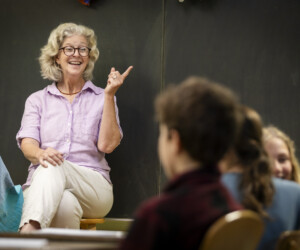
SWS’s own Melissa McIntyre has been voted one of the best Teachers of the Year in Lancaster County - an honor that speaks to her deep dedication, skill, and love for her students.
Since joining SWS in 2003 as a Kindergarten teacher, Mrs. McIntyre has become a beloved guide, mentor, and leader among our talented faculty. Her calm, nurturing presence and passion for Waldorf education have supported countless students and families over the years.
Beyond the classroom, Melissa is the proud mother of three SWS alumni and a joyful grandmother to the next generation of SWS students. She embodies the warmth, wisdom, and sense of community that make our school so special.
Congratulations, Melissa! Your work inspires us all. 💚
Why Waldorf Education Shines in Lancaster County
At SWS, we believe education is more than academics — it’s about nurturing curiosity, creativity, and compassion. Through a curriculum rich in imagination, movement, music, and nature, students at SWS learn to think independently, act with empathy, and approach the world with wonder.
As Lancaster County’s Best Private School, we’re proud to offer families a holistic education that prepares children not only for high school and beyond, but for a lifetime of purposeful living and joyful learning.
Thank You, Lancaster County!
 We’re so grateful to Lancaster County Magazine and our wonderful community for this recognition. To every student, parent, teacher, alum, and friend of SWS - you are the reason we shine.
If you’re new to SWS or curious about what makes Waldorf education unique, we invite you to visit our campus, meet our teachers, and experience the magic for yourself.
Explore the full Best of Lancaster issue at LancasterCountyMagazine.com.
💛 Ready to learn more? Schedule a Tour

Festivals as Living Lessons: How Waldorf Traditions Nurture Courage and Connection
As the seasons turn, the rhythm of the year unfolds at Susquehanna Waldorf School in a cycle of celebration, reflection, and gratitude. Each festival—whether Michaelmas Festival of Courage, Martinmas, or May Day—carries a story, an image, and a gesture that meets the child where they are developmentally. Through song, story, and shared experience, these festivals become more than mere events; they are living lessons that awaken courage, reverence, and a deep sense of belonging.
Michaelmas Festival of Courage: Meeting the Dragon
In the golden light of early autumn, the festival of Michaelmas calls us to awaken our inner strength and face the “dragons” within and around us. Waldorf schools celebrate Michaelmas as a festival of courage and renewal, inspired by the story of Archangel Michael, recognized across many world religions and cultures as a symbol of light overcoming darkness. This image reminds us that bravery is not the absence of fear, but the willingness to act with goodness and resolve even when faced with challenge.
For the youngest children, the spirit of Michaelmas lives in the simple rhythm of their days, gathering the harvest, kneading and baking bread, singing songs that carry warmth into the turning year. For older students, the stories and reflections deepen into questions of moral courage: How can I meet the challenges before me with compassion and strength? The entire community, students, teachers, and parents alike, comes together in this shared gesture of courage, carrying the light of the season into the darker months ahead.

Festival Life as Community Life
At SWS, festivals are the heartbeat of our school year, weaving together the threads of school and home life. The preparations themselves become acts of community and devotion: teachers craft stories and songs; students rehearse plays, dances, or processions; and parents lend their care and creativity to support each celebration.
In a world that often moves too quickly, these moments invite us to pause, to breathe, and to come together for a shared purpose. Festivals help children experience that they are part of something greater than themselves: a living, loving community that honors both the turning of the natural world and the seasons of the human heart.
Light in the Darkness
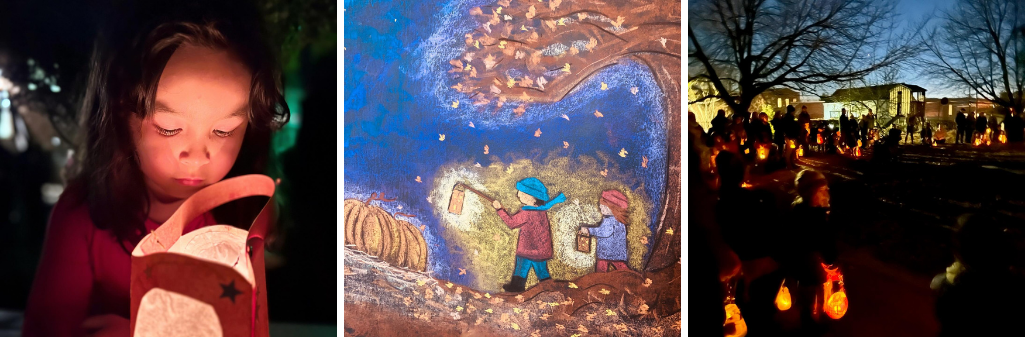
As autumn deepens and daylight wanes, festivals such as Martinmas and the Spiral of Light offer quiet beauty and inner warmth. The flicker of candlelight becomes a symbol of the light that endures within each of us, even through darkness and stillness. In these moments, reverence is not an idea but an experience, felt in the glow of a child’s face, the sound of voices raised in song, and the hush that falls when a single flame is carried through the dark.
Why We Celebrate
In Waldorf education, festivals are not performances or calendar markers; they are living expressions of the human journey. They honor the cycles of nature and the spiritual unfolding of the child, teaching through experience that joy, courage, and gratitude are part of life’s rhythm. Through celebration, we affirm again and again that courage can be practiced, kindness can be cultivated, and community is something we create together through intention and love.
As we gather for our autumnal festivals this year, may we each find courage in the turning of the seasons, gratitude in the work of our hands, and light in one another. These are the gifts our children carry with them, the enduring magic of Waldorf education.

The Value of a Waldorf Education Today
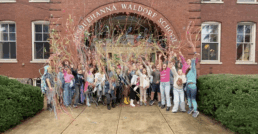
On the first day of school, a familiar scene unfolds at Susquehanna Waldorf School. Children carry bright backpacks, photos are taken in front of the brick archway, parents linger with hugs and goodbyes, and there’s a quiet hum of anticipation in the air. Year after year, we ask families: What brought you here?
The answers often sound like this:
“We wanted our child to be known.”
“We wanted an education that nurtures imagination and joy.”
“We wanted something different.”
These aren’t just words, they’re the heartbeat of why families choose Waldorf education. In a world where schooling can feel hurried, standardized, and disconnected from the rhythms of childhood, Waldorf offers something rare: a place where children grow not only in knowledge, but in wonder, compassion, and courage.
A Mission With Heart
At SWS, everything begins with our mission: to cultivate in each student the clarity of thought, sensitivity of feeling, and strength of will to live as free, responsible individuals who can bring purpose and meaning to their lives and to the lives of others.
Because we are mission-driven, not bound by state or corporate mandates, we can craft a responsive curriculum that reflects what children truly need today: intellectual rigor, yes, but also creativity, resilience, and compassion.
What does this look like day to day? Class 7 teacher Melissa McIntyre shares, “There are times when I have something in mind and I look at them and can tell, "they need to move their math today, they don’t need to write their math.” Keeping it surprising for them. Especially in the winter, it’s really important to keep it fresh in other ways. There have also been numerous times when I’ve brought a lesson, and I can sense how it interests them, so I changed the next couple of lessons to keep going in that direction. I make sure I meet all of their curiosities about a topic.”

Small Classes, Big Connections
Step into one of our classrooms, and you’ll notice right away: it feels personal. With an average student–teacher ratio of 10:1, every child is seen. Every voice matters.
This closeness allows teachers to know their students deeply, their strengths, their struggles, their quirks, their dreams. And that makes all the difference. When children feel safe, noticed, and valued, they are willing to take risks, make mistakes, and grow in ways that surprise even themselves.

Learning With Head, Heart, and Hands
Education at SWS is not just about filling minds; it’s about engaging the whole child. Our approach balances academics with artistic, practical, and physical learning:
- In math, children might paint a geometric progression with watercolors.
- In history, they might bring a story alive through drama.
- Outside, in all seasons, nature becomes their classroom.
- In Handwork and Practical Arts, they learn patience and persistence through knitting or woodworking.
- In Middle School, technology is introduced mindfully, so students don’t just use digital tools—they understand them through our Cyber Civics program.
This blend of intellect, creativity, and practical skill equips children not just for tests, but for life itself.

A Partnership With Families
Waldorf education is rooted in partnership. Parents are not bystanders here, they are allies. Festivals, class meetings, and volunteer opportunities weave families into a rich community life. Children feel that circle of love and support surrounding them, and it strengthens everything we do together.
Parent to three current students, Asia Pecora reflects, “When we came here, we found a place where we were able to have meaningful conversations and we developed relationships with our children’s teachers. So much trust was built.”
Lifelong Benefits
The true value of Waldorf education cannot be measured by a test score. It shows up in the spark of curiosity in a child who asks big questions. In the resilience of a student who doesn’t give up when things get hard. In the compassion of a graduate who goes into the world eager to make a difference.
At Susquehanna Waldorf School, we are proud to be more than a school. We are a community where children are inspired to live with purpose, joy, and connection.
Come see for yourself. Schedule a visit this fall and discover how Waldorf education can nurture your child’s growth.

Waldorf Summer: Enriching Activities for Your Child
As the school year winds down and summer approaches, many parents begin seeking ways to keep their children engaged, joyful, and connected during the break. At Susquehanna Waldorf School, we believe that summer is not just a pause in education; it's an opportunity for meaningful, developmentally appropriate enrichment that nourishes the whole child.
Waldorf-inspired summer activities offer children a slower, more intentional rhythm of life, rooted in creativity, connection to nature, and hands-on exploration. In this post, we’ll share ideas for Waldorf-aligned summer fun and explain how these experiences support your child’s growth in ways that are joyful, screen-free, and deeply enriching.
Why a Waldorf-Inspired Summer?
Waldorf education recognizes that children thrive when their senses, imagination, and need for movement are honored. Summer provides the perfect backdrop for this kind of holistic engagement:
- Unstructured play gives children space to explore and self-direct.
- Nature immersion builds curiosity, resilience, and wonder.
- Artistic expression fosters creativity and emotional well-being.
- Rhythmic routines create a sense of safety and flow, even when school is out.
Whether you’re home with your children, traveling, or attending summer programs, a Waldorf lens can help shape experiences that are truly restorative and meaningful.

Simple and Enriching Summer Activities for All Ages
Whether they’re in early childhood or upper elementary/middle school, your child can find joy in unplugged, hands-on experiences that nourish creativity and imagination. Here are ideas for both younger and older children:
Crafts & Activities for Younger Children (Preschool–Grade 2)
- Nature Crowns & Flower Wands – Collect leaves and blossoms to craft playful summer accessories.
- Wet-on-Wet Watercolor Painting – Explore colors blending together in simple, meditative ways.
- Bubble Play with Homemade Wands – Shape wire into stars or hearts and dip in a homemade soap mixture.
- Finger Knitting or Simple Handwork – Gentle rhythm work that builds dexterity and focus. Get a tutorial here.
- Seasonal Storytime & Puppet Play – Create simple characters with felt or wool and act out seasonal tales. Get inspired with this list of seasonal Waldorf books.
Crafts & Activities for Older Children (Grades 3–8)
- Woodworking Projects – Try carving a simple spoon, birdhouse, or walking stick with safe tools and supervision.
- Embroidery or Weaving – Choose age-appropriate patterns and create bookmarks, patches, or mini tapestries.
- Journal Making – Bind a handmade nature or art journal using recycled paper, thread, and covers.
- Herbal Creations – Make your own salves, teas, or dried flower sachets with guidance.
- Story Writing & Comic Creation – Use summer as a launchpad for imagination through storytelling.
These hands-on, screen-free activities invite children to enter a state of flow, where learning, joy, and development meet naturally.

Susquehanna Waldorf School Summer Programs
Looking for structured Waldorf-inspired programming during the summer? Susquehanna Waldorf School offers two enriching and imaginative camps in August 2025:
- String Orchestra Camp (Grades 6–8, August 4–8): A creative and collaborative experience for young musicians, featuring ensemble rehearsals, improvisation, and a culminating performance.
- Chinese Culture Camp (Grades 3–8, August 11–15): A hands-on journey through Chinese festivals, storytelling, shadow puppetry, and traditional games like Chinese jump rope, yo-yo, and more.
Each camp blends joyful exploration with cultural enrichment and hands-on learning, true to the Waldorf spirit. Programs are screen-free, deeply engaging, and rooted in rhythm, creativity, and connection.
Visit susquehannawaldorf.org/summer-camps to learn more and register!
Tuesday Family Playground Days at SWS
Tuesdays, June 17 – August 12 | 9:30 AM – 12 PM
Come play, connect, and enjoy the beauty of our outdoor space this summer! These informal Tuesday morning playdates are a great opportunity for new and returning families to gather. Bring a friend, pack a snack, and relax while your children explore and play.
- Free & open to the public - bring a friend!
- Bathrooms and filtered water are available
- A great way to stay connected to the SWS community all summer long!
We hope to see you there!

The Benefits of a Waldorf Summer
Choosing Waldorf-style summer activities means choosing:
- Less screen time, more nature time
- Creative thinking over passive entertainment
- A slower, more present pace of life
- Connection with natural rhythms
- Opportunities for whole-child development
As research continues to highlight the importance of play, time outdoors, and creativity for children’s well-being, Waldorf-inspired summer enrichment offers a time-tested, joyful path forward.
Let Summer Be a Season of Wonder
At SWS, we believe that summer should reflect the same values we uphold during the school year: reverence for childhood, connection to the Earth, and trust in the power of imagination. With just a bit of intention, your child’s summer can be not just fun, but truly transformative.

Technology: When & How It’s Used At Susquehanna Waldorf School
At the Susquehanna Waldorf School (SWS), we believe in a mindful and purposeful approach to technology education. Rather than introducing screens at an early age, we prioritize experiential, hands-on learning that fosters deep thinking, creativity, and social connection. When students reach middle school, they engage with digital tools in a structured and developmentally appropriate way, ensuring they develop the skills necessary to be competent, responsible, and creative digital citizens.
Our approach aligns with both Waldorf education principles and modern scientific research, demonstrating that introducing technology at the right time, when students have developed strong foundational skills, leads to a more meaningful and productive relationship with digital tools. At SWS, students do not passively consume technology; they learn to use it as a tool for research, problem-solving, and ethical communication.
Why Timing Matters in Technology Education
Educational research shows that a strong foundation in critical thinking, problem-solving, and interpersonal communication enhances a student's ability to use technology effectively. Studies from the American Academy of Pediatrics and researchers like Dr. Dimitri Christakis suggest that early exposure to screens can impact attention spans and cognitive development. By focusing on immersive, hands-on learning in early childhood and elementary school, we prepare students to engage with digital tools thoughtfully and purposefully in middle school.
A study from UCLA further supports this approach, finding that children who spent time away from screens showed significant improvements in their ability to read human emotions—an essential skill for communication and collaboration. At SWS, we nurture these critical abilities before introducing technology in a structured curriculum that builds both technical competence and ethical awareness.

Middle School: A Purposeful Introduction to Technology
When students reach middle school, SWS gradually integrates technology through a comprehensive and carefully designed curriculum. Each grade level builds on the previous one, ensuring that students develop digital literacy in a way that enhances their learning while maintaining a balanced and healthy relationship with technology.
Sixth Grade: Establishing Digital Foundations
Students begin by developing keyboarding proficiency using the “Rapid Typing” program, which helps them build accuracy and speed. They also engage with Cyber Civics: Level 1 - Digital Citizenship, where they learn about online privacy, social media safety, ethical communication, and digital reputation. This foundation ensures that students approach technology with awareness and responsibility from the very start.
Curriculum for Keyboarding Skills:
“RAPID TYPING” PROGRAM
- The Introduction and Beginner courses help students to learn the position of keys on the keyboard. After completing this course, students will know which finger to use to hit each key without looking at the keyboard. The course also covers upper-case letters, special symbols, and the numeric pad.
- The Experienced course helps students to improve typing speed by memorizing frequently used syllables and words.
- The Advanced course helps students to perfect the skills acquired by typing an actual text.
Curriculum for Digital Literacy:
“CYBER CIVICS” LEVEL 1: DIGITAL CITIZENSHIP
- Investigating Technology
- Citizenship Today
- Digital Reputation
- Thinking Ethically Online
- Digital Communications
- Social Media Safety
- Cyberbullying
- Digital Drama
- Offline Bullying
- Hate Speech
- Online Privacy
- Presenting Yourself Online
Seventh Grade: Expanding Digital Competence
Building on sixth-grade skills, students advance their digital literacy with Cyber Civics: Level 2 - Information Literacy. They explore topics such as web searching, evaluating online sources, understanding algorithms, and managing personal information. Practical applications of technology are introduced through word processing, collaborative writing in Google Docs, and project creation using Google Classroom. By this stage, students integrate digital tools into their academic work while maintaining a thoughtful approach to their usage.
Curriculum for Digital Literacy:
“CYBER CIVICS” LEVEL 2: INFORMATION LITERACY
- Searching the Web
- Constructing Search Queries
- Reading a Results Page
- Personal Info Management
- Algorithms, Filter Bubbles
- Copyright, Plagiarism
- Searching the Web
- Constructing Search Queries
- Reading a Results Page
- Personal Info Management
- Algorithms, Filter Bubbles
- Copyright, Plagiarism
Eighth Grade: Mastering Media Literacy and Research Skills
Eighth-grade students engage with Cyber Civics: Level 3 - Media Literacy for Positive Participation, exploring topics such as misinformation, media representation, and the impact of artificial intelligence. They also refine their technical skills by incorporating research tools, spreadsheets, and multimedia applications into their academic projects. By the end of middle school, students are well-prepared to navigate the digital world with confidence, ethics, and creativity.
Curriculum for Digital Literacy:
“CYBER CIVICS” LEVEL 3: MEDIA LITERACY FOR POSITIVE PARTICIPATION
- Consumption vs. Production
- Multitasking
- Tech “Addiction”
- What's “News” Today?
- Detecting Misinformation
- Visual Literacy
- Media Representation
- Clickbait, Deepfakes
- Sexting, Sextortion
- Research Skills
- Artificial Intelligence

Technology as a Tool for Learning and Innovation
Rather than viewing technology as an end in itself, SWS sees it as a tool for deeper learning, problem-solving, and creative expression. Our middle school students are encouraged to explore programming, 3D printing, and robotics, providing them with opportunities to develop technical skills in a meaningful way.
Research from the Organisation for Economic Co-operation and Development (OECD) indicates that students who develop digital skills at a later stage, after establishing strong cognitive and social foundations, tend to perform better academically than those who are introduced to screens too early. This reinforces our belief that the right time and method of technology integration matter just as much as the tools themselves.
This balanced and developmentally informed approach helps Waldorf graduates thrive in a wide range of fields—including STEM. In fact, a 2017 study from the Research Institute for Waldorf Education found that 42% of Waldorf graduates pursue careers in science, mathematics, engineering, and technology. These numbers reflect the power of an education that prioritizes curiosity, deep thinking, and thoughtful engagement with tools and ideas.
A Balanced and Thoughtful Approach
The Susquehanna Waldorf School’s approach to technology is intentional, research-based, and developmentally appropriate. By introducing digital tools in middle school through a structured curriculum, we prepare students to be not just consumers of technology, but responsible, ethical, and creative digital citizens. Our students transition to high school with a deep foundation in critical thinking, collaboration, and innovation—empowered to use technology as a tool for meaningful learning and contribution to the world.

The Gift of A Waldorf Education: A Comprehensive Look At SWS's Curriculum
Waldorf education offers students an intentional, holistic approach to learning that emphasizes the whole child's development. It nurtures children by introducing academics through developmentally appropriate methods, ensuring that students are not just memorizing facts but truly understanding and applying their knowledge in meaningful ways.

Nature, Play, and Experiential Learning
Waldorf education is known for its alignment with nature and play-based learning. All students spend time outside year-round, jumping in puddles in their rain gear, sledding down snowy hills, and exploring the verdant banks of the Susquehanna River. While it’s easy to see that nature and play are core components of a Waldorf education, what makes it truly special is how they enhance academic learning. Time spent in nature fosters curiosity, creativity, and resilience, qualities that are deeply integrated into the curriculum.
The Waldorf approach to academics stands in stark contrast to traditional education. It emphasizes experiential learning, integrates art to support learning across disciplines, encourages social and emotional development, and fosters a lifelong love of learning in students. Unlike public and private schools that follow rigid curriculum standards, Waldorf education is highly adaptable, evolving to meet the developmental needs of each student.
Great care is taken to craft a curriculum that meets students developmentally rather than forcing them to meet standardized benchmarks beyond their readiness. For example, Waldorf early childhood education prioritizes social-emotional learning before age seven while actively laying the groundwork for reading, writing, and language skills. Oral storytelling in early childhood builds vocabulary, comprehension, and grammar skills. Repeating familiar stories enhances memory and narrative structure. These foundational skills help prepare students for the more formal academic instruction that begins in first grade.
In first grade, Waldorf educators introduce language skills through active and engaging methods. Children draw pictures from letters (like capital B as a bear with a big belly) to connect visual imagery with letter sounds. This aligns with research showing that phonics-based instruction is highly effective for teaching reading. Through songs, movement, and storytelling, children develop a strong foundation in language arts that prepares them for independent reading and writing.
“In first grade, we’re planting seeds of what’s to come,” said Waldorf Educator Rochelle Dietz. “Students recognize patterns later on and connect the songs they learned in first grade to concepts in geometry in middle school … Learning is not just happening in their heads … It’s a whole-body experience: head, heart, and hands.”
Learning comes to life in a Waldorf classroom, engaging and exciting students in meaningful ways. To witness a Waldorf student learning is to witness joy.
The Importance of Nature and Movement
At every level, Susquehanna Waldorf School prioritizes movement and time spent in nature. All students experience recess twice a day, ensuring they have ample opportunities for unstructured play and physical activity. In addition to recess, nature walks and outdoor learning are integral parts of the curriculum, even in middle school. These experiences support physical health, cognitive development, and emotional well-being, reinforcing the connection between mind and body. By integrating movement and nature into daily routines, Waldorf students develop a deeper appreciation for the world around them while enhancing their ability to focus and engage in academic work.
What Do Students Learn in a Waldorf Curriculum?
Public schools often emphasize standardized test preparation, while Waldorf education offers a broad, integrated curriculum that fosters critical thinking and creativity. Core subjects include:
- Language Arts: Phonics, reading, creative writing, grammar, public speaking, and literature study. Younger students learn to write before reading, forming letters through artistic storytelling.
- Mathematics: Introduction of four mathematical processes in Grade 1, progressing to fractions, decimals, geometry, business math, and algebra in middle school.
- Science: A hands-on approach covering nature studies, botany, zoology, physics, chemistry, biology, astronomy, and physiology.
- Social Studies & History: Rich storytelling introduces students to ancient civilizations, mythology, local geography, U.S. history, and world history, following the development of human consciousness.
- World Languages: Spanish, Mandarin, and Latin are taught through song, movement, and conversation. Celebrating festivals enhances cultural awareness and appreciation.
- Practical Arts & Handwork: Watercolor painting, drawing, sculpting, knitting, sewing, woodworking, carving, and other craft-based skills to develop fine motor abilities, hand-eye coordination, and creativity.
- Music & Performing Arts: Singing, instrumental music (recorder, string instruments), choral work, and drama performances.
- Physical Education & Movement: Eurythmy (a form of movement unique to Waldorf education), cooperative games, running, balance exercises, and traditional sports.
Interdisciplinary Learning Across Grade Levels
Each grade level in a Waldorf school offers hands-on projects that integrate multiple disciplines, reinforcing knowledge retention and fostering creativity. Field trips are an essential component, allowing students to experience real-world connections to their studies.
1st Grade: Fairy Tales & Handwork
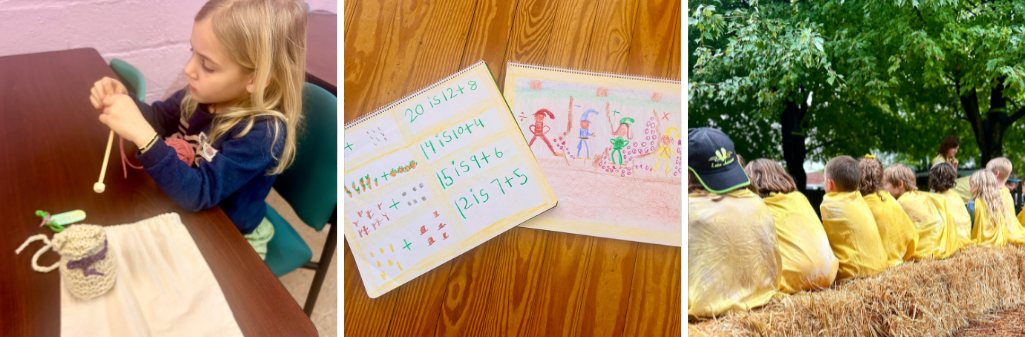
First grade marks the beginning of the second developmental phase, spanning ages 7 to 14. This phase focuses on the idea that “The world is beautiful.” Imagination flourishes, and students learn best through stories, art, and experiential learning.
Fairy tales and nature stories spark curiosity and wonder. Painting, drawing, and storytelling lay the foundation for writing, while math is introduced through engaging narratives. Unlike traditional schools, Waldorf introduces all four mathematical operations in first grade. Spanish and Mandarin are taught through song, movement, and games. Other subjects include Music and Eurythmy.
Curriculum Summary:
- Language Arts: Storytelling through fairy tales and nature stories; introduction to writing through painting and drawing; active instruction in letter sounds and phonics concepts.
- Math: Introduction to addition, subtraction, multiplication, and division through imaginative stories.
- World Languages: Spanish and Mandarin are taught through song, movement, and games.
- Other Studies: Nature exploration, music, form drawing, movement-based learning.
2nd Grade: Fables & Legends
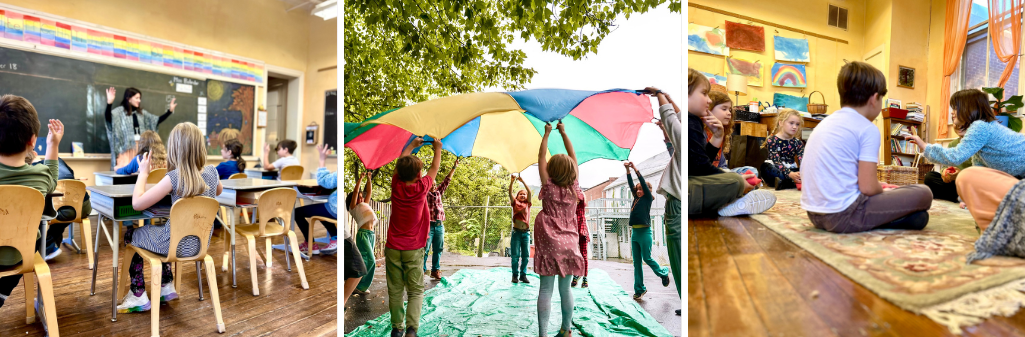
In second grade, children become increasingly self-aware and begin to explore the complexities of their world. The curriculum provides tools to engage with newfound independence and navigate social conflicts. Second graders explore Aesop’s fables, which help develop moral reasoning and literacy skills. They also study animals, comparing their characteristics and behaviors to human traits. Students in all Grades create illustrated morning lesson books, reinforcing both artistic and language skills.
Curriculum Summary:
- Language Arts: Aesop’s fables and stories of heroes reflect students’ social-emotional growth.
- Math: Expansion of arithmetic, rhythm-based multiplication learning.
- Science: Hands-on exploration of nature and simple scientific observations.
- Other Studies: Artistic work (painting, drawing, modeling), world languages, movement games.
3rd Grade: Farming & Self-Sufficiency
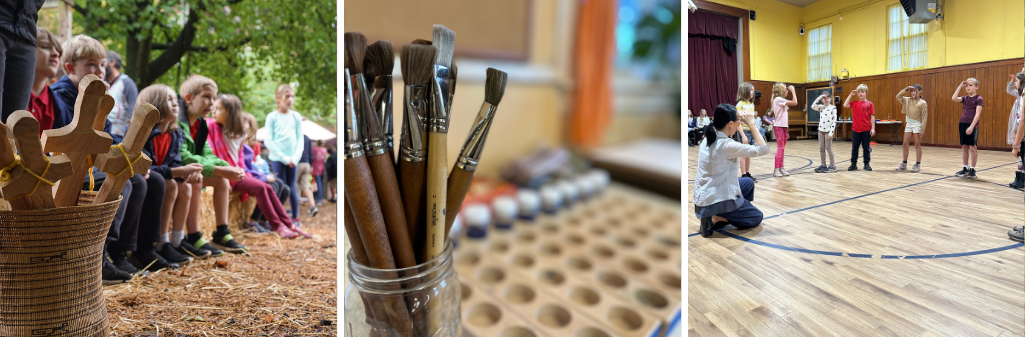
Third grade is a “doing” year, focusing on practical knowledge. As third graders learn about measurement, time, and self-sufficiency, they participate in gardening and farming projects. They might construct a small shelter or bake bread, applying math and science concepts in a practical setting. A field trip to a working farm solidifies these lessons, immersing students in an environment where they see food cultivation in action.
Curriculum Summary:
- Practical Studies: Farming, cooking, measurement, shelter-building.
- Math: Practical applications—telling time, measuring, handling money.
- Language Arts: Introduction to grammar, continued storytelling, and illustration.
- Music: Introduction to C-flute and string instruments.
- Experiential Learning: Multi-day farm trip for hands-on agricultural and practical life skills.

4th Grade: Norse Mythology & Local Geography
Fourth grade marks a developmental shift, as children leave early childhood behind and engage more critically with the world. Fourth graders explore Norse mythology, bringing ancient stories to life through storytelling and drama. They also study local geography, mapping their communities and learning about regional history, reinforcing their sense of place. A field trip to a historical site or nature reserve deepens their connection to their environment and local geography.
Curriculum Summary:
- History & Mythology: Norse mythology parallels students’ adventurous spirits.
- Geography & Science: Local geography and zoology.
- Math: Introduction to fractions and more complex problem-solving.
- Arts & Music: Form drawing, part-singing, orchestra.

5th Grade: Ancient Civilizations & the Pentathlon
Fifth grade is known as the “Golden Age of Childhood,” a time of balance and harmony. Students explore human history from ancient India to Greece, recognizing the interconnectedness of civilizations. The study of ancient cultures in fifth grade culminates in a Greek Pentathlon, where students embody the athleticism and philosophy of ancient Greece. Training for this event integrates history, physical education, and even art. Students might recreate artifacts or jewelry from Ancient Egypt. A visit to a history museum deepens their appreciation for the artifacts and stories of early civilizations.
Curriculum Summary:
- History: Ancient civilizations from India to Greece; comparative Mythology.
- Math: Decimals, fractions and geometry.
- Science: U.S. geography, botany, woodworking.
- Athletics: Greek Pentathlon celebrates strength and agility.
6th Grade: Introduction to Cyber Civics & Geology
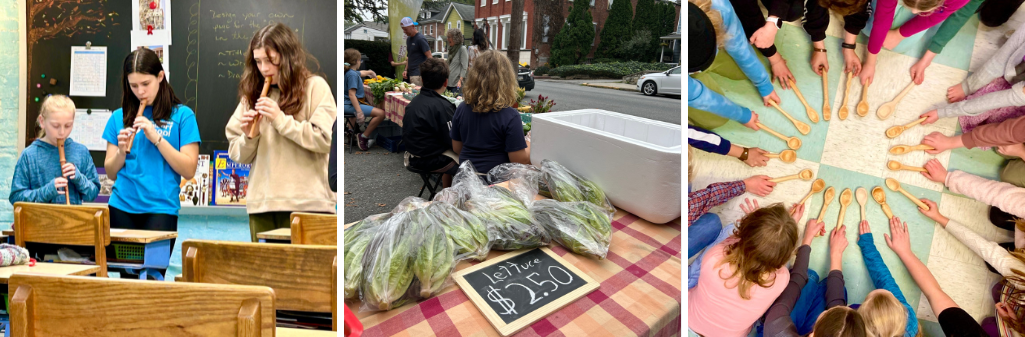
Sixth grade marks the dawn of reason and perception. The study of astronomy and geology expands a student’s awareness of their place in the universe. Students at SWS often take a trip to New York City to explore the Natural History Museum and the architecture of historic churches and buildings. Physics is hands-on, engaging students with experiments in acoustics, magnetism, and electricity. The curriculum continues to be experiential, allowing students to participate actively in their learning.
Technology is intentionally delayed in Waldorf schools to encourage creative and critical thinking without reliance on screens. In sixth grade, students are introduced to the Cyber Civics curriculum, which teaches digital literacy, online safety, and responsible technology use.
Curriculum Summary:
- History: Ancient Rome through the Middle Ages.
- Science: Physics (light, sound, magnetism, electricity), mineralogy, astronomy.
- Math: Business math, geometry, and algebra introduction.
- Experiential Learning: Hands-on physics experiments to foster inquiry and critical thinking.

7th Grade: Renaissance & Mechanics
Seventh grade is a year of exploration and self-discovery as students transition from childhood to adolescence. The curriculum mirrors this transformation by studying the Renaissance, engaging in perspective drawing, and learning about the impact of art, science, and exploration. Perspective drawing and world geography encourage students to see the world—and themselves—in new ways.
They also delve into mechanics and simple machines, constructing working models of pulleys and levers in Physics. A visit to Philadelphia’s museums provides an opportunity to learn more about American History.
Curriculum Summary:
- History: Renaissance, Age of Exploration.
- Science: Chemistry, physiology, advanced physics.
- Math: algebra, geometric perspectives.
- Language Arts: Creative writing, poetry.
- Experiential Learning: Hands-on physics.
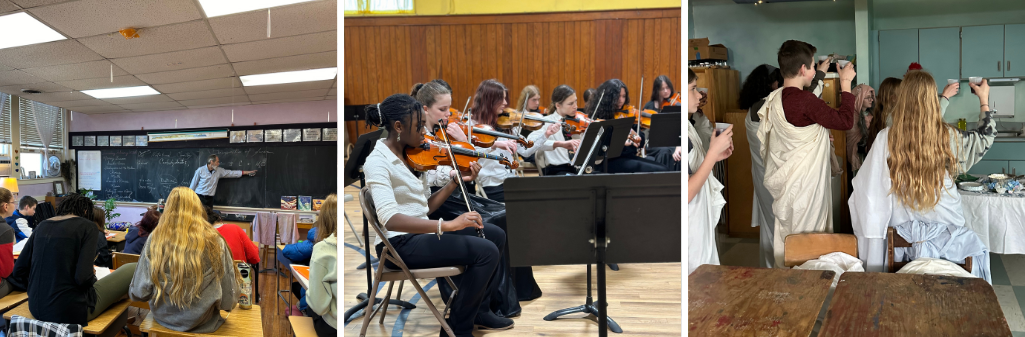
8th Grade: Capstone Project & Final Trip
Eighth grade is a year of deep inquiry and synthesis. Students explore complex historical and scientific concepts, such as revolutions, electromagnetism, and organic chemistry. They also read and perform Shakespeare and analyze poetry, refining comprehension and vocabulary skills.
A highlight of the year is the Eighth Grade Project, a culmination of each student’s independent research and creative effort. This project reflects each student’s personal interests and integrates various disciplines. These projects, presented to the school community, serve as a testament to students’ growth and achievements.
In addition, an eighth-grade trip serves as both an educational and celebratory experience, reinforcing the bonds formed throughout their journey in Waldorf education and providing a meaningful transition to high school.
Curriculum Summary:
- History: Reformation to Revolution.
- Science: Organic chemistry, fluid mechanics, electromagnetism.
- Math: Algebra, advanced geometry.
- Language Arts: Shakespeare, historical literature.
- Capstone Project: Eighth Grade Project—an independent research and presentation project marking their transition to high school.
The Waldorf Approach
Research supports the effectiveness of Waldorf education. A study conducted by the Stanford University School of Education found that Waldorf students excel in critical thinking, creativity, and problem-solving compared to their peers in traditional schools. Another study published in the Journal of Educational Research and Evaluation indicates that Waldorf graduates report high satisfaction with their education, noting that the interdisciplinary and experiential approach prepared them well for higher education and careers.
By focusing on developmental readiness, hands-on learning, and real-world connections, Waldorf schools cultivate lifelong learners who retain their knowledge far beyond their school years. By meeting students at each developmental stage, SWS ensures they grow into well-rounded, confident individuals, ready to thrive in any high school setting and beyond.
