
Walk into a Waldorf first-grade classroom as students are learning about letters, perhaps the letter “K.” There is no worksheet in sight.
Instead, you might hear about a noble King who rules his Kingdom with courage and kindness. You might see children standing tall like royal guards, tracing the tall, strong lines of the letter K in the air. And one day, when the King must travel, the Council Cat, clever and whiskered, climbs onto the throne to “speak for the King.”
Suddenly, the letters aren’t just symbols on a page.
They have weight. Shape. Personality. Story.
And long after the page is turned, that letter lives in the child’s imagination.
At Susquehanna Waldorf School, imagination isn’t decoration. It is the doorway through which understanding enters.
Imagination as the Seed of Learning
Before children can grasp abstract ideas, they must experience them. They must feel them, picture them, move with them.
Rudolf Steiner, the founder of Waldorf education, once said:
“Imagination is the foundation of all higher knowledge.”
In the early grades, we see this truth unfold daily.
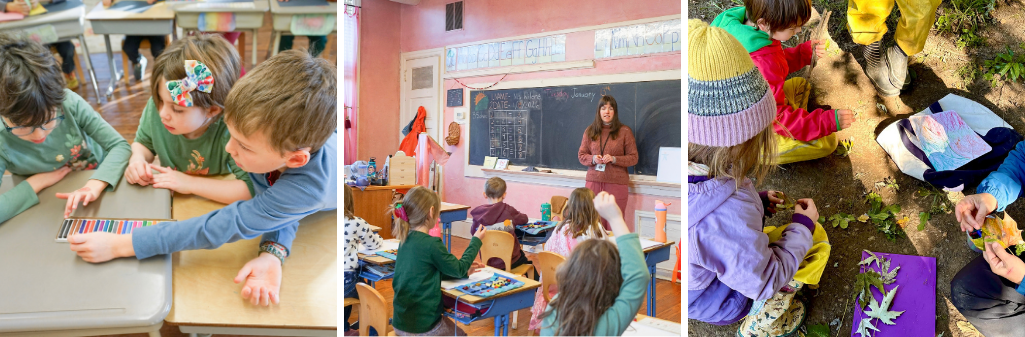
In math, numbers are not introduced as detached symbols. A teacher may tell a story of four woodland friends gathering acorns for winter. The children move the acorns, draw them, and experience what “fourness” feels like. Multiplication becomes rhythmic clapping and stepping patterns before it becomes a written algorithm.
In science, a third-grade class doesn’t begin with definitions of erosion. They begin outside, hands in soil, watching water carry earth across the schoolyard after a rainstorm. They draw what they observe. They tell the story of what the water did. Only later do formal terms arise.
This approach is not about fantasy for its own sake. It is about making ideas vivid enough that children can enter them fully, intellectually and emotionally. When learning begins in experience and imagination, it sticks. It becomes part of who students are.
Supporting the Whole Child
Imagination nourishes every dimension of development.
Cognitive Growth
When children picture a story problem before solving it, or imagine multiple endings to a historical turning point, they practice flexible thinking. They learn to approach challenges from more than one angle.
Emotional Depth
In fourth grade, students study local geography by first hearing the story of the land, how rivers carve valleys, how mountains rise. The land is not a diagram; it is alive with meaning. Students begin to feel connected to place, not just informed about it.
Social Understanding
In middle school history, students step into the lives of those they study—debating as senators in ancient Rome or taping paper beneath their desks to sketch overhead, catching a small glimpse of what it may have felt like for Michelangelo painting the ceiling of the Sistine Chapel during the Renaissance. Imagination becomes the bridge to empathy. They begin to ask not just what happened, but why someone might have believed as they did.
This integration of thinking, feeling, and doing lies at the heart of Waldorf education. Imagination is what weaves them together.

Imagination Across the Curriculum
Imaginative learning does not live in one subject. It moves through the day.
- Language arises from poetry, story, and rich oral tradition before grammar rules are abstracted.
- Math is carried in rhythm, movement, and narrative before it is symbolized.
- Science begins in careful observation and wonder before analysis.
- History is encountered as human drama before it becomes a timeline.
In fifth grade, students reenact the ancient Greek Olympics, feeling the cultural spirit of the time before studying its political structures. In middle school physics, students observe phenomena like the arc of a pendulum or the behavior of light before deriving the formulas that describe them.
Because ideas are first experienced, they are remembered. Understanding grows from within, rather than being placed from without.
Preparing Children for a Changing World
The future will not reward memorization alone. It will ask for creativity, resilience, empathy, and original thinking.
Children who are encouraged to imagine boldly are more likely to:
- Ask meaningful questions
- See connections others miss
- Approach problems with flexibility
- Offer ideas that are new, not rehearsed
Imagination is not the opposite of rigor. It is the source of innovation.
When a child has spent years bringing letters to life, walking through stories, shaping ideas with their hands, and picturing possibilities beforesolving them, they develop an inner resourcefulness that extends far beyond the classroom.
Joy as the Current Beneath Learning
There is something unmistakable about a classroom where imagination is active.
You see it in the way first graders lean forward during a story.
In the hush that falls when a teacher begins a historical tale.
In the laughter that bubbles up during a rhythmic math exercise.
Learning feels meaningful. Alive. Worth doing.
When joy is present, children do not ask, “Will this be on the test?”
They ask, “What happens next?”
And that curiosity becomes the engine of lifelong learning.
Imagination is not an extra.
It is how children come to know the world deeply and humanly.
If you would like to see imaginative learning in action, we invite you to visit Susquehanna Waldorf School and experience how imagination shapes every grade, from the first story to the final project.